
.avif)
November 6, 2025

In this article
1. The Actual Problem Nobody Talks About
2. What Staying Visible Actually Requires
3. Why You Keep Failing
4. The System (Actual Steps)
5. Three Types of Posts That Work
6. When the System Breaks Down
7. When DIY Stops Making Sense
I'll save you the preamble about LinkedIn having a billion users. You know the platform matters. That's not why you're here.
You're here because you've tried to post consistently and failed. Probably more than once. You started strong—maybe even kept it up for a few weeks—and then a client deliverable landed, or a product launch hit, or life just happened. One skipped day became a skipped week. A skipped week became a month of radio silence.
Now you're reading this, half-hoping there's some trick you missed and half-suspecting the answer is going to be "just be more disciplined."
It's not.
Discipline isn't your problem. Systems are.
The Actual Problem Nobody Talks About
Here's what most LinkedIn advice gets wrong: it treats posting as a habit to build, like going to the gym or drinking more water. Just commit! Make it a priority! Schedule it!
That advice assumes content is competing for attention alongside everything else in your day. It's not. Content is competing against revenue-generating work. And revenue-generating work wins every single time—as it should.
When you have a client waiting on a deliverable and a LinkedIn post that nobody's expecting, the deliverable wins. There's no shame in that. It's rational prioritization.
The problem is that content IS revenue-generating work. You just don't see the invoice until six months later when someone hires you because they've been watching you post and decided you're the person for the job.
So you're stuck in a loop: content feels optional in the moment, but the cost of skipping it compounds invisibly until you notice your pipeline has dried up and you can't trace it to any single decision.
What "Staying Visible" Actually Requires
Let's get concrete.
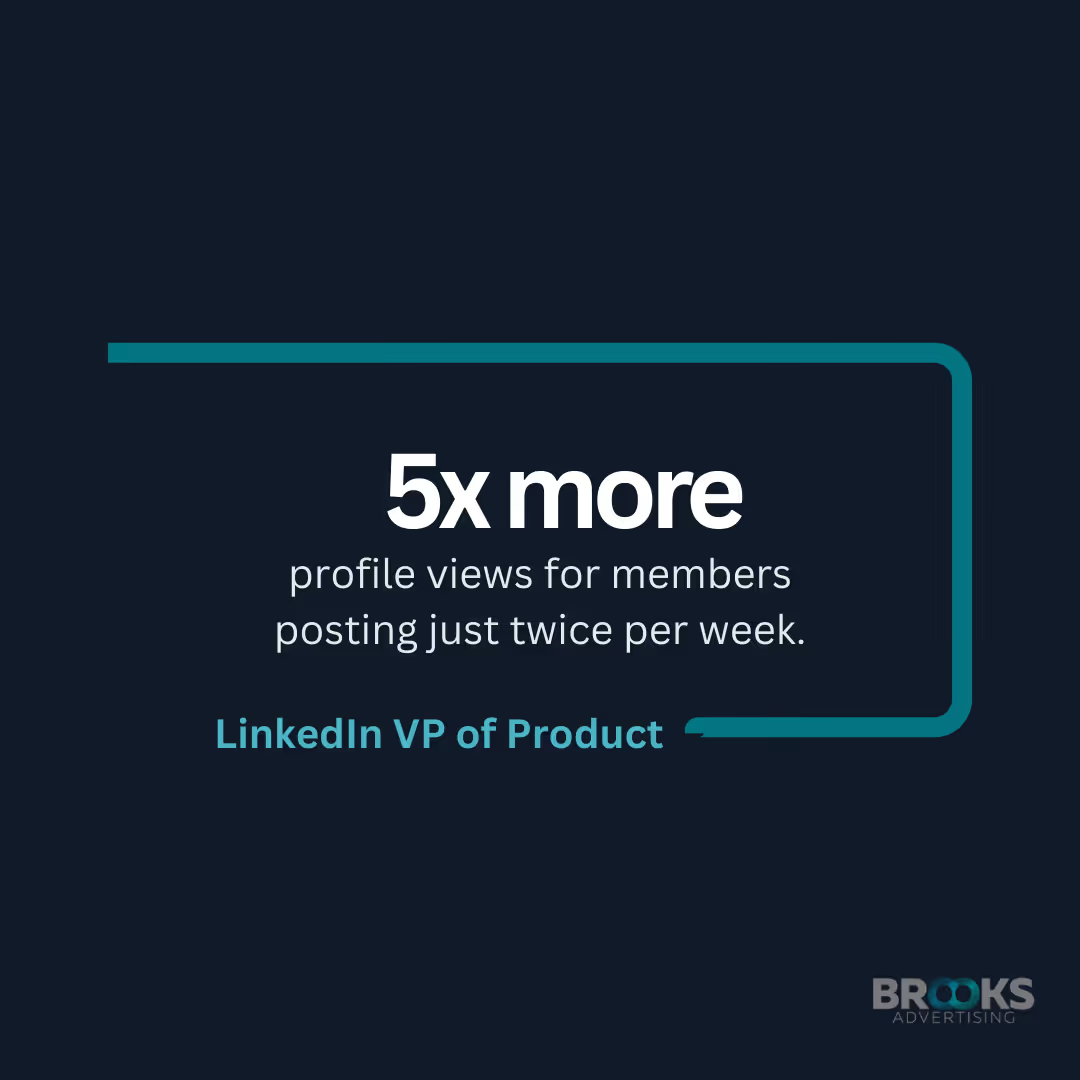
Buffer analyzed over two million LinkedIn posts last year. The finding that matters: accounts posting 2-5 times per week see meaningful lifts in reach—and the jump from once a week to twice correlates with up to five times more profile views.
You don't need to dominate anyone's feed. You need to stop disappearing from it.
That means, at minimum:
Two posts per week. That's the floor. Below that, you're not posting enough for the algorithm—or your audience—to remember you exist.
Showing up on a predictable rhythm. Tuesday and Thursday at 9am, every week. The specific days matter less than the consistency.
Engaging for 10-15 minutes on the days you post. Not "great post!" comments. Actual responses that add something. This signals to LinkedIn that you're a real person participating, not a bot dumping content.
That's it. That's the baseline for visibility. Two posts, predictable schedule, brief engagement. Maybe 90 minutes of total weekly effort if you're efficient.
The question isn't whether you have 90 minutes. It's whether those 90 minutes will consistently go to content when they're competing against everything else.
Why You Keep Failing (It's Not What You Think)
I've talked to enough consultants and business owners to see the pattern. The failure mode isn't laziness. It's structural.
You're starting from scratch every time. Each session, you sit down with a blank screen and have to decide what to write, find the angle, generate the energy. That startup cost is brutal when you're already depleted from actual work.
There's no forcing function. Clients have deadlines. Content doesn't. Nobody's angry if you skip this week. So you skip this week.
The comparison trap kills you. You scroll past someone with 50,000 followers posting polished insights daily and think "I can't compete with that." So you don't try.
You don't have a system—you have intentions. And intentions lose to urgency every time.
Here's what actually works: you need to separate the creation from the publishing, batch the work so you're not cold-starting constantly, and create enough runway that a busy week doesn't crash the whole operation.
The System: Actual Steps, Not Platitudes
Step 1: Build a content bank before you need it.
Stop trying to think of something to post in the moment. Instead, keep a running note—phone, doc, whatever—and capture ideas as they happen.
Every time you explain something to a client that makes their eyes light up: write it down. Every time you see a post and think "that's wrong" or "that's missing something": write it down. Every time you have an opinion about your industry that differs from consensus: write it down.
Do this for two weeks before you start posting. Aim for 20-30 ideas. Most will be half-baked. That's fine. You need raw material, not finished posts.
Step 2: Batch your writing.
Block 60-90 minutes once a week. No email, no Slack, no calls.
Write 4-6 posts in one sitting from your idea bank.Don't publish immediately. Just draft. Let them sit overnight if you can—you'll catch awkward phrases with fresh eyes.
This single change transforms content from a daily burden into a weekly block you can protect.
Step 3: Schedule everything.
Load your posts into LinkedIn's native scheduler or a tool like Buffer. Set your posting days.
Walk away.The goal is to decouple "creating" from "publishing" so you're never scrambling. If you batch on Friday, you should have Tuesday and Thursday covered for the next two weeks minimum.
Step 4: Engage on posting days only.
You don't need to live on LinkedIn. Spend 10-15 minutes on the days your posts go live. Comment on a few posts from people whose audiences overlap with yours.
Respond to anyone who comments on your post within the first hour if possible.That's enough. The algorithm rewards early engagement, not constant presence.
The Three Types of Posts That Work
Not all content is created equal. After watching what performs across industries, three categories consistently pull weight:
Expertise Posts
Demonstrate what you know. A framework you use with clients. A mistake you see repeatedly. A counterintuitive insight from your work. These build authority—they're why people eventually trust you enough to pay you.
Proof Posts
Show you can deliver. Client results (anonymized if needed). Before-and-after scenarios. Testimonials. Numbers from your track record. In a platform full of people claiming expertise, proof separates signal from noise.Rotate through all three. You're not always teaching, not always selling, not always sharing—you're mixing modes so your feed has texture.
Story Posts
Make you human. A lesson you learned the hard way. A decision you made and what happened because of it. A belief you hold that differs from your industry's conventional wisdom. These create connection that pure information can't touch.
When the System Breaks Down
It will. You'll have a brutal week. You'll get sick. Something will demand all your attention.
If you miss a day: Post next time you're supposed to. Don't mention the gap.
If you miss a week: Same thing. No apology tour. Just show up with something valuable.
If you miss a month: This is where most people stay gone. The restart feels too heavy.Here's the truth your brain won't tell you: your audience doesn't remember your absence nearly as much as you do. They're not keeping track. When you post again, most will engage like nothing happened.
The hardest part of coming back is psychological. So make it mechanical: pick your next posting day, write one post, publish it. Then do it again. Momentum rebuilds faster than you expect.
The Point Where DIY Stops Making Sense
Some people can sustain this system indefinitely. They have the discipline, they protect the time, they don't mind the work. Most can't. And there's no moral failure in admitting that.
You've probably reached the delegation point if:
• The start-stop cycle has repeated more than twice
• Content consistently falls off your list despite good intentions
• LinkedIn visibility directly affects your pipeline
• You have the expertise but genuinely not the hours
At that point, you have options. Hire a freelancer and manage them yourself. Work with a ghostwriter who learns your voice over time. Use a done-for-you service that handles everything.
What doesn't make sense: continuing to treat content as something you'll "get to" when things calm down. Things won't calm down. Your competitors aren't waiting.
How Brooks Kits Solves This
I'll be direct about what we do, since you're on our site.
Brooks Kits is a done-for-you content service. You fill out one intake form—fifteen minutes, covers everything we need to know about your business, your audience, and your voice. That's the last time you brief anyone.
On the first of every month, your content lands in a portal. LinkedIn posts, emails, sometimes blogs depending on your package. Written, organized, labeled by week. You copy, paste, and schedule. No calls. No draft reviews. No back-and-forth.
Three tiers:
Spark ($179/month): 2 emails, 8 LinkedIn posts. Baseline visibility.
Authority ($399/month): 4 emails, 12 LinkedIn posts, 1 SEO blog. Most popular.
Lead Engine ($699/month): Everything in Authority plus lead magnet, landing page copy, and welcome sequence.
The pitch isn't that we write better than you could. It's that we write instead of you—so it actually gets done, every month, without requiring your attention.
If you've tried the DIY route and it hasn't stuck, this is what solves it.
The Bottom Line
LinkedIn isn't about being the loudest voice. It's about being present enough, consistently enough, that when someone needs what you offer, your name surfaces first.
The people who win at this aren't more talented writers. They're not more disciplined. They've just found a way to make content happen reliably—whether that's a personal system they protect fiercely, or delegation that removes them from the equation.
Either path works. What doesn't work is hoping this time will be different without changing anything structural.
Figure out your path. Then stop thinking about it.
More on this:
How Often to Post on LinkedIn in 2026
LinkedIn Content Ideas for Consultants
Should You Outsource Your LinkedIn Content?
You know you should post on LinkedIn. You're not going to do it consistently. Here's the system that actually works.
February 6, 2026
How to Stay Visible on LinkedIn (Without It Becoming Your Job)

Everyone wants the magic number. There isn't one—but there's a range that works, and posting more than you think might be hurting you.
January 2, 2026
How Often to Post on LinkedIn in 2026

You know things clients pay real money to learn. Here's how to turn that expertise into posts—plus 30 specific ideas you can steal this week.
January 16, 2026
LinkedIn Content Ideas for Consultants (30+ That Actually Work)

When hiring out your LinkedIn content makes sense, when it doesn't, and what the tradeoffs actually are. No sales pitch—just a straight answer.
February 2, 2026
Should You Outsource Your LinkedIn Content?

Most small business owners know content matters. Few do it consistently. Here's what's actually happening—and the fixes that work when willpower doesn't.
February 16, 2026
Why Small Businesses Struggle with Content Marketing (And What Actually Works)

You've decided to outsource content. Now: freelancer or done-for-you service? Here's the honest breakdown of cost, time, quality, and what actually works.
January 22, 2026
Done-for-You Content vs. Freelancer: Which Is Right for You?